CAMERA OBSCURA

Author Positioning
I am the founder and managing director of a management consulting agency with specialist focus on leadership and organisational performance, with twenty-six years of professional practice. My work spans leadership, culture, and organisational performance across complex systems where decisions carry human, organisational, and ethical consequence. This doctorate arises from sustained professional practice rather than detached observation.
Why This Doctorate
This doctoral inquiry is driven by a recurring problem observed in practice: leadership effectiveness is predominantly judged through visible performance outcomes, while the upstream organisational conditions from which those outcomes emerge remain under-examined and under-named. The work interrogates the consequences of this outcome-centric logic for leadership judgement, organisational life, and sustainability.

The Organising Metaphor
Camera obscura is the organising metaphor for this thesis. A camera obscura is a dark chamber in which light enters through a small aperture, producing an image that becomes visible only through disciplined containment. In retrospect, the aperture embedded in The Performance Agency’s identity prefigured the central thesis claim: that performance is too often pursued as an endpoint rather than read as an outcome of conditions. What was once expressed operationally is here articulated theoretically.
Without disciplined aperture, illumination distorts; indicators are mistaken for causes, and what appears visible can invert. Two threads run through the chamber. The first, Spirit, names the animating human energy that gives life to work: purpose, care, imagination, and commitment. The second, Accountability, names the structural conditions through which intention is translated into action and held to consequence.
This thesis argues that these threads are not opposites to be balanced but a paradox to be held, and that the capacity to hold them, Paradox Literacy™, can be designed into organisational architecture rather than left to individual leaders.
Selected Public Works
This submission presents two public works selected from a broader professional portfolio because they offer depth, longitudinal insight, and comparative sense-making at scale:
A five-year engagement within a South African retail organisation employing approximately 35,000 people, examining leadership, culture, and performance through the Service-Profit Chain. This work foregrounds the deliberate architecture of conditions under relative commercial stability, testing how Spirit and Accountability can be aligned at scale.
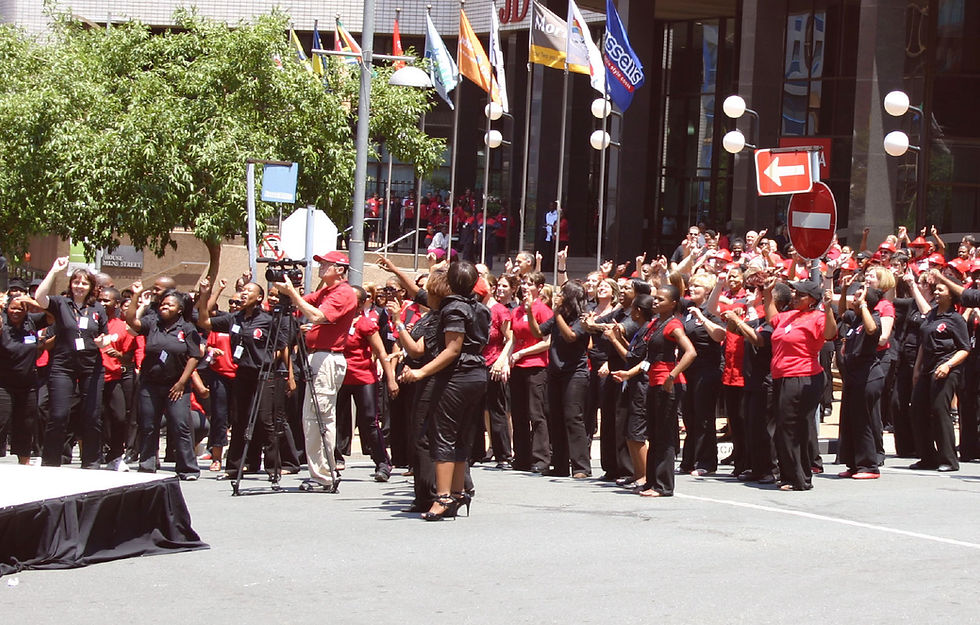
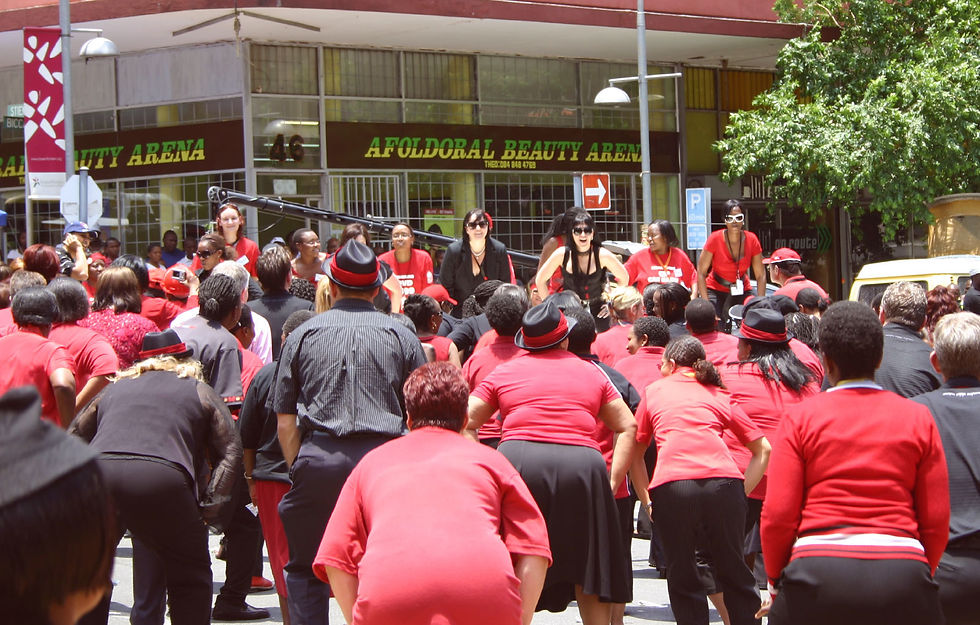


An eight-year journey with a leading African financial institution, beginning as the organisation emerged from formal regulatory administration following institutional failure, and unfolding through a prolonged period of regulatory oversight before culminating in preparation for an initial public offering (IPO).[1] This work tests leadership as a governed condition under regulatory, temporal, and market constraint, examining what happens when the Spirit-Accountability tension must be held under pressure and consequence.
[1] An IPO is the formal process through which a privately held company lists its shares on a public exchange and becomes subject to public disclosure obligations, investor evaluation, and market pricing, where leadership was deliberately designed as a system condition rather than treated as individual capability, and culture was elevated from narrative aspiration to priced organisational risk.




Together, these two public works provide contrasting organisational conditions, one demonstrating the deliberate architecture of culture under relative stability, and the other testing leadership as a governed condition under regulatory and market constraint, through which the performance consequences of Spirit and Accountability are examined over time.
Methodological Orientation
This inquiry forms part of a Doctor of Professional Studies by Public Works and is conducted using analytic autoethnography (Anderson, 2006) as the primary critical lens. The Deep-Insight Cycle, a five-stage reflective protocol developed within this thesis, operationalises the retrospective examination of each public work through disciplined movement from encounter through reflection, interpretation, theoretical connection, and insight. The work is situated within a transdisciplinary orientation, drawing pragmatically across leadership studies, organisational psychology, systems thinking, and performance science without claiming disciplinary mastery.
Outcomes and Contribution
This doctorate reframes leadership as an organisational condition rather than an individual attribute, and performance as an emergent outcome of conditions rather than a controllable endpoint. It identifies a category error in contemporary leadership governance: the mistaking of performance indicators for causal drivers, and the consequent neglect of the conditions leaders create, permit, or tolerate. The thesis advances three doctrinal claims: that leadership capacity functions as an upstream variable preceding performance; that regression in leadership conditions is asymmetrical, destroys value faster than improvement creates it, and needs active governance; and that the capacity to hold the Spirit-Accountability paradox, Paradox Literacy™, is a designable organisational condition, not a personal trait.
Ethical Considerations
All organisational material is presented with consent obtained through direct consultation with the organisations and individuals named. Where organisations and individuals are named, this is done following explicit permission, with due regard for ethical responsibility and professional integrity. The author's dual positioning as practitioner and researcher, and the relational obligations this produces, are addressed in Chapter 2. Arrangements for redaction and embargo, where applicable, have been discussed with the supervisory team and the university.
Chapter Guide
This thesis is structured as a single argumentative arc. Two threads, Spirit and Accountability, run through every chapter, examined as a paradox to be held rather than a tension to be resolved. The chapters build sequentially toward three doctrinal claims which are presented in Chapter 5.
Chapter 1 situates the inquiry within macro, meso, and micro contexts, establishing the conditions and paradoxes shaping leadership practice.
Chapter 2 sets out the methodological architecture, including analytic autoethnography, the Deep-Insight Cycle, transdisciplinary positioning, and ethical discipline.
Chapters 3 and 4 present the two public works in depth, integrating analytic reflection with situated narrative to examine leadership and organisational conditions at scale. Chapter 3 foregrounds architectural design under stability; Chapter 4 tests governance under constraint. Together, they provide the comparative evidential base from which the doctrinal claims are drawn. The evidential conventions governing how practitioner material appears in both chapters, including the citation format, footnote structure, and archive navigation, are set out in the Appendix Navigation below.
Chapter 5 consolidates the doctoral contribution through doctrinal synthesis, articulates the scope and boundary of the claims, and closes by reflecting on practice evolution and the frontier of future inquiry.


Appendix Navigation
The evidential base underpinning this thesis is drawn from two sustained professional engagements that produced, collectively, approximately 1,700 archival assets, including diagnostic data, governance artefacts, facilitation materials, programme documentation, correspondence, and longitudinal measurement outputs. Not all of this material is equal in evidential relevance, and not all of it is required for the argument to be followed. The appendices have therefore been selected with the examiner as the end user, structured to provide both transparency of the evidential base and clarity in how evidence is used in the argument.
Archival Identification
The full asset base for each public work was catalogued and reviewed in relation to the claims advanced in Chapters 3, 4, and 5. This review established which materials are relevant to the thesis argument, while retaining the broader archive for completeness and auditability.
Evidential Selection
Evidence is introduced into the main body of the thesis only where required to sustain a claim. Selection is claim-led and guided by three criteria:
Evidential necessity: whether the asset performs a role that cannot be removed without weakening the claim
Causal contribution: whether the asset demonstrates mechanism, movement, or sequence rather than description
Non-duplication: whether the evidential work it performs is already sufficiently carried by another source
The intention is not to present the full archive within the chapter, but to construct a disciplined evidential spine in which each retained asset performs clear and necessary work in supporting the argument.
Evidential Structure
Each substantive claim is supported by a primary evidential anchor, referenced in the text and detailed in the accompanying footnote. Where additional assets are necessary to establish the source base, provide triangulation, or clarify longitudinal context, they are named as supporting sources rather than separate claim anchors.
The chapter is therefore designed to be self-contained: the argument can be followed without recourse to the appendices, while the underlying archive remains available for verification, interrogation, and depth where required.
Evidence Mapping
The claim structure for Chapter 3 is set out in Appendix A: Claims List, Chapter 3, JD Group Public Work. Appendix A identifies 24 claims across three doctrinal groupings and makes visible the argumentative propositions that require evidential support.
The evidence assets supporting those claims are set out separately in Appendix B: Evidence Asset List and Claim Mapping, Chapter 3, JD Group Public Work. Appendix B lists the assets actually drawn on in Chapter 3, identifies the claim or claims each asset supports, and explains the evidential function each asset performs.
Together, Appendix A and Appendix B make the evidential logic of Chapter 3 visible without requiring the reader to work through the full archive. Appendix A defines what is being claimed; Appendix B identifies the assets that support those claims and explains the evidential function each asset performs. The appendices therefore function as a navigation and verification structure, enabling precise movement between the chapter’s claims and the evidence on which they rest.
Chapter 4 follows the same evidential convention, with practitioner material introduced only where it is required to sustain the argument. Its evidential structure will be aligned to the final Chapter 4 architecture and to the doctrinal claims consolidated in Chapter 5. At this stage, Appendix A and Appendix B set out the completed Chapter 3 claims list and asset mapping; the corresponding Chapter 4 evidential structure will be finalised once the Chapter 4 claim architecture is settled.
The Archive
The archive comprises the wider set of evaluated assets generated through the two public works. These assets are not reproduced as a static appendix. Instead, Appendix B lists the assets actually drawn on in Chapter 3, while the wider archive remains available for verification where required. Where asset identifiers appear in citations or footnotes, they route the reader to the corresponding evaluation card, allowing the archive to be navigated through the argument rather than separately from it. The archive is structured to support selective engagement, enabling the examiner to interrogate specific claims without being required to traverse the full archival base.
Navigational Principle
The thesis operates on a simple principle: the argument is primary; the archive is available. Evidence, therefore, is deployed only where required, prioritising clarity and causal precision